.
This is the medieval section of StormTheCastle.com

- Knights
- Castles
- Games
- Weapons/Armor
- Articles
- Medieval Names
- Medieval Words
- Medieval Terms
- Medieval Jobs
- Medieval Maps
- The Armory

Wills Books

Dictionary of Medieval Terms
This is the dictionary of medieval terms. It covers a lot of territory including weapons of the knight, parts of castles and medieval life in general.
You can quick jump down the page to the topics:
Phrases in use today - Knight Stuff - Medieval life - Medieval People - Weapons and armor
Phrases still used today - that have roots in medieval times
Carry your heart on your sleeve - During tournaments a knight would often wear on his sleeve a favor from a lady such as a ribbon or veil.
Chink in the armor: Refers to weak spots in real armor such as gaps where different armor parts met.
Crestfallen: This refers to the crests on the tops of knights helmets during tournaments. In some tournaments the goal was to knock off the opponents crest.
Run the Gauntlet: A dangerous risk or dangerous undertaking. The gauntlet was a form of punishment for swedish and german military where a person being punished would have to run between two facing rows of soldiers who would strike him.
Knight in Shining Armor - This appears to be a compliment but could be used as a slight. The point being that if a knights armor were shining he was not tested in combat.
Panache - This was the name of feather endowed crests on the tops of helmets during the renaissance. They could be very bright and extravagent.
A man of letters - is felt to be complimentary today, but in the 15th century, it was an insult thrown by knights at each other, that your foe was a mere scribe or clerk and not worthy to carry a sword. sourced from Joanot Martorell in "Tirant lo Blanc" 1490.
Knight stuff
Chivalry - A code of good behavior that knights would follow. Honor, gallantry, courtesy and generosity were often tenets of chivalry. More extensive coverage of the subject of chivalry: Medieval Knight Chivalry
Coat of Arms - A symbolic bade that a knight would wear to show he belonged to a certain family, king or duke. These coats of arms were also often displayed on shields.
Fealty - An oath of allegiance paid by a knight to his lord or by a lower person to his knight. Sometimes this fealty was in the form of money or possessions. Often it was in the form of an oath to serve, protect and defend.
Jousting - mock combat between mounted knights. this was often performed with Lances.
Melee - A battle with more than two combatants.
Page - A young boy around the ages of 8-10 who would work for a knight usually doing household work or grooming and care of horses.
Squire - A young teen boy who was a personal assistant to a knight. He often carried messages and weapons/armor for the knight. He would help the night in his preparation for battle.
Free-lance - a knight or mercenary soldier who held no particular allegiance except to those who would hire him for pay.
Medieval Life
Crusades - A period of time in the middle ages from the 11th to 13th centuries where a series of military actions were undertaken on behalf of the pope and religious beliefs. Knights would travel to the holy lands from the Muslims. These holy lands were once occupied by christian forces but were taken over by Muslim forces. There were nine crusades in all.
Dark Ages - The period of time approximately from 500 AD to 1000 AD. It was a time of unrest, frequent warfare, uncertain living circumstances and much uncertainty.
Feudalism - a system of life and government in Western Europe from around the ninth through fifteenth centuries. It was a system of rights and properties. And it stemmed out the lack of a strong centralized government. There were many lords, barons, kings and land owners. The feudal system defined the relationships between all these people and it covered all people from kings to the lowest of peasants. Some of the basic components of feudalism were chivalry and knighthood.
Guild - A trade association where craftsmen of the same trade ban together and establish rules of conduct, quality, education and standards. They also maintain and control pricing of crafted items. A guild will often have a set schedule for apprentices to learn and master the denoted craft.
Middle Ages - A period of time in European history covering roughly ten centuries from the 5th century to the 16th century. This span of time does change and the British Middle ages are generally considered to be the period of time from 1066 to the end of the 15th century.
Renaissance - A cultural movement characterizing great artistic growth spanning a period of time roughly from the 14th to 17th centuries.
Scutage - A tax or fee paid by wealthy sons in order to forego military service as knights.
Siege Engine - Any of a number of large war machines used to destroy the armaments and fortifications of a castle. There is a wide variety of siege engines from catapults to trebuchets, siege towers and battering rams. I have more extensive information about them here: Siege Engines
Vassal - A person who owed allegiance to someone above him in the feudal system. Knights could have many vassals that owed allegiance to them.
Vassalage - This refers to the term of the relationship between high ranking men of the ruling class. For example the relationship between two knights or a knight and his king.
Heroit - The tribute in payment due to a lord or king upon the death fo a vassal.
Words and terms related to medieval weapons and armor
Bluing - A heat treatment applied to the surface of a meta to tint it blue
Bog Iron : A form of Iron ore found in bogs and swamps
Bolt: A projectile used for a crossbow, resembling a short, thick arrow.
Close helmet: A closed-faced helmet with faceplates that pivot upward to open it.
Comb Morion: - An open faced helmet having an elevated crest or combrunning front to back along the top.
Crucible steel: - A form of high carbon steel , noteworthy for it's hardness.
Cuirass: - Armor for the torso, consisting of a breastplate and backplate.
Doublet - A tailored jacket, worn either as civilian clothing or underneath armor.
Field armor : Armor made for battlefield use, as opposed to tournament armor
foot tourney : A form of tournament combat fought on foot.
Garniture: A suit of armor with exchange pieces that can be traded in and out to configure it for different uses, such as combat on horseback, on foot, or in a tournament.
Gorget: - Armor for the neck, also serving to distribute the weight of the cuirass; later worn in reduced form as a badge of rank.
Hilt: - The part of a blade weapon below the blade, consisting of the grip and whatever other fittings are present, such as a handguard or pommel.
Lance Rest: - A fitting that attaches to the breastplate near the right armpit, serving to help the armored horseman control his spear.
Longsword - A straignt, two-edged sword that can be wielded with either one or two hands, sometimes called a hand and a half sword.
Pauldron:: Armor for the shoulder.
Poleaxe: A staff weapon having a head featuring an axe.
Pommel: A metal cap or teminal attached at the end of a sword below the hand.
Reinforce: - An element of armor that can be added to a suit for extra protection.
Spetum: - A staff weapon having a long blade flanked by two forward curving points.
Swept hilt: - A sword hilt featuring multiple protective bars surrounding the unarmored hand.
Tasset - Armor for the upper thigh, suspended from the torso armor.
Tilt: In jousting, a barrier that separates the contestants from each other.
Peasecod breastplate: A breastplate shaped with a prominent shape at the belly.
Medieval People
Armiger - A squire
Bard - A singer and/or musician who sings tales of the deeds of people.
Carabiner: a type of mounted soldier, wearing a helmet and breastplate and armed with a sword and a short firearm called a carbine.
Count - In Europe it is the highest rank that can be attained by a person without having royal blood. Equal to the rank of Early and one step below Duke.
Cuirassier - A mouinted soldier wearing heavy armor, typically armed with a sword and a pair of pistols.
Duke - Title for members of the royal family.
Earl - The highest rank that an english person can attain without having royal blood.
Harquebusier - A type of mounted soldier, wearing light armor and armed with a sword and a short firearm called a harquebus.
Heavy Infantry/cavalry: Heavily equipped soldiers specializing in close-quarter combat.
Knight - A soldier trained in armed combat and sworn fealty to a king, lord or duke.
Minstrel - A poet and singer who travels and entertains the aristocratic class.
Paladin - A type of knight, originally linked to Charlemagne,. Now often to be considered appropriate for any chivalrous and heroic knight.
Pikeman - A footsoldier wearing armor and armed with an extremely long spear called a pike.
Sapper - A military engineer involved in digging trenches and building fortifications for siege warfare.
Serf - A semi free peasant who works for a lord by working the land and paying dues to the lord.
Sergeant - A knight of lesser rank
Vavasseur - A landed free man who has not attained the rank of knight
More Medieval word play you might like
Fascinated by words!!
Medieval Words - Medieval Names - Medieval Jobs
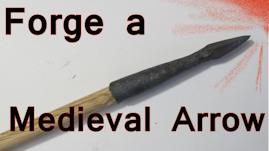 Forge Medieval Arrows - (I actually forged one up on my forge and I can show you how it's done) This style of arrow tip is called a bodkin and it was used in the middle ages and the Renaissance. They are easy to make and I show you how. Forge medieval arrows
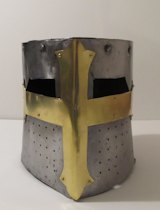 Forge a Medieval Great Helm - This is an interesting medieval armor project. I show you the process step by step. Note though that the helmet project isn't complete yet. I am waiting on some rivets to arrive so I can button it up and finish it. But you can check it out here: Make a Medi eval Great Helm