Home

Will's Youtube Channel!






Hi, Thanks for visiting my website. My name is Will and if you have questions
or would like to
contribute projects or ideas you can contact me 
Go to the Table of Contents for this booklet

The Stars and Constellations
Because of the rotation of the earth the stars will move across the sky during the course of the evening. The only star that does not move is the north star. This is because the north star is aligned directly with the axis of the earth. The north star is not very bright but you can find it easily if you first find the big dipper. The big dipper is probablyl the easiest constellation to find. Look to the north and see if you can find it. When you have found it you can use it to find the north star and the little dipper. The two end stars in the bowl point directly toward the north star.
Remember that because of tthe rotation of the earth the big dipper may be turned in a different orientation than that shown in the following drawing.
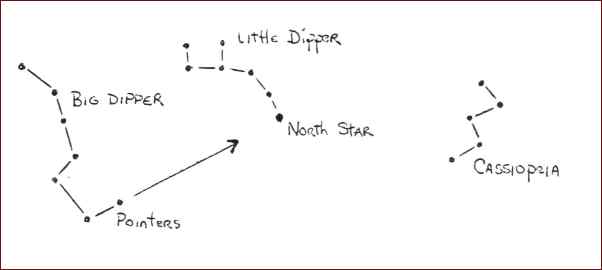
Having found the big dipper and the north star you should be able to make out the other stars that make up the little dipper. And on the other side of the little dipper you can see a W shaped constellation that is called Cassiopeia the queen of Ethiopia. There are five constellations in the general area of the north star that make up a group called the circumpolar constellations. The remaining two are called Cepheus the king of Ethiopia and Draco the Dragon. The star map below will help you to find them.
Using The Star Chart
For ease of use you should carefully cut out the circular star chart and clue it to a piece of cardboard. Face north and with your chart held in front of your rotate the chart so that the current calendar month is directly up. This is the way the circum polar stars are aligned at approximately 9 pm (10 pm Daylight savings time). If the hour is earlier rotate the chart clockwise the distance of one of the smaller lines - one line for each hour. If the time is later rotate the star chart counter clockwise one line for each hour.

The Constellations:
Some of the constellations are easier to identify than others. You should first try to find the easy ones and then use them to help you find the harder ones that are nearby. Be patient. With a little bit of time and practice you will be able to identify all the constellations and if you have found two or three in one evening then you have done very well. In the springtime a good first constellation to start with is Leo. In the summer begin with Hercules. In autumn Pegasus is a good place to start and in winter Orion is an easily found constellation.
The Milky Way
The Milky Way is visible at almost any hour throughout the year. There are dashed lines on the star map below to show you how it stretches itself across the sky. To see it you must be sure that your eyes are well adapted to the dark and there is very little light pollution. It will appear to be a faint white band almost like a whisp of cloud.
The Planets
If you find a bright star in the sky that is not on the star map you may have found a planet! Venus, Jupiter, Mars, and Saturn all can be very bright and easily seen at different times of the year. If all the stars twinkle and shimmer but the star you have found doess not twinkle then it is most like a planet. Planets do not twinkle like stars do. Because the planets change their positions among the stars throughout the course of the year you should consult a website, almanac, or magazine about astronomy in order to find their exact locations for any given evening.
The star map below shows the major constellations that are visible n the whole sky. You use this map in the same way as the previous map. Below the map is a list of the major constellations and the names of some of the brighter stars.

 Continue on to Telescopes and Binoculars
Astronomy and telescope related books & products

 Night Sky Star Wheel
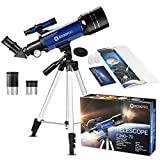
Telescope for Kids Beginners Adults, 70mm Astronomy Refractor - Perfect Telescope Gift for Kids
- No-tools quick set up and easy find your objects, perfect telescope gift for kids and astronomy beginners
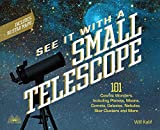
See it With a Small Telescope -
Take the mystery and struggle out of discovering new worlds. With hands-on tips, tricks and instructions, this book allows you to unleash the full power of your small telescope and view amazing space objects right from your own backyard.

 Janice VanCleave's Astronomy for Every Kid: 101 Easy Experiments that Really Work (Science for Every Kid Series)
Why do planets spin? How hot is the Sun? What keeps the Moon in orbit around the Earth? What are Saturn's rings made of? What's a black hole in space? Now you can discover the answers to these and other fascinating questions about basic astronomy. In Astronomy for Every Kid you'll learn about the constellations using a shoe box planetarium. You'll chart the movement of the stars with nothing but a string, a marker, and a nail. And you'll use a toy magnet to simulate the Earth's protective force field. Each of the 101 experiments is broken down into its purpose, a list of materials, step-by-step instructions, expected results, and an easy to understand explanation. Every activity has been pretested and can be performed safely and inexpensively in the classroom or at home. Also available in this series from Janice VanCleave: Biology for Every Kid Chemistry for Every Kid Dinosaurs for Every Kid Earth Science for Every Kid Geography for Every Kid Geometry for Every Kid The Human Body for Every Kid Math for Every Kid Physics for Every Kid


A Child's Introduction to the Night Sky: The Story of the Stars, Planets, and Constellations--and How You Can Find Them in the Sky
Children eight and up will enjoy this conversational but information-packed introduction to astronomy and stargazing, which includes the achievements of the great scientists, the history of space exploration, the story of our solar system, the myths behind the constellations, and how to navigate the night sky. Whimsical color illustrations on every page and handy definitions and sidebars help engage younger readers and develop their interest. The special star wheel helps locate stars and planets from any location at any time of year. This is the third in Black Dog & Leventhal's successful series including The Story of the Orchestra and A Child's Introduction to Poetry.